

TeenTech
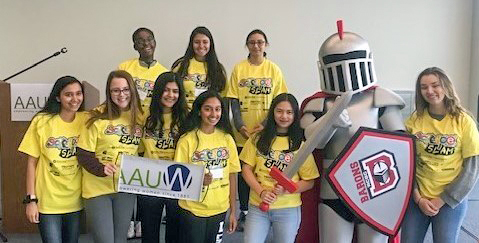
Teentech is a one-day event designed to demonstrate that STEM (Science, Technology, Engineering and Math) education and careers are exciting, relevant, and accessible to girls and women. Teentech participants engage in laboratory, engineering, and math workshops presented at a host college/university, giving them confidence-building experiences in a real college setting. The event is often run on a school day as an approved school field trip from each attending district. The educators who accompany the girls participate in their own hands-on workshop in the morning and a panel discussion session in the afternoon.
Teentech has been a project of the American Association of University Women of New Jersey (AAUW NJ), held in collaboration with a host college/university, for nearly 20 years. Key partners that have lent their expertise in the past to Teentech include Institute of Electrical & Electronics Engineers (IEEE), NJ Technology and Engineering Educators Association., and the NJ School Counselors Association.
For questions about Teentech events please email – AAUW NJ Teentech Coordinator: aauwnj@gmail.com
TeenTech 2025
May 3: Rowan College at Burlington County
TeenTech 2023
May 25: Essex County College
TeenTech 2022
May 25 at Atlantic Cape Community College Sponsored by AAUW Atlantic County Branch, AAUW Cape May Branch,
Atlantic Cape Community College Foundation and funded by
a grant from South Jersey Industries
TeenTech 2019
May 3: Rowan College at Burlington County
May 29: Stockton University
May 31: Montclair State University
TeenTech 2018
May 22: Bloomfield College
May 23: Atlantic Cape Community College
May 30: Georgian Court University
TeenTech 2017
May 22: Ramapo College,
May 23: Stockton University
TeenTech 2016
June: Atlantic County Community College (ACCC)
June: Seton Hall University
February: Essex County College
TeenTech 2015
February: Essex County College
May: Stockton University
TeenTech 2014
May: Georgian Court University
Why TeenTech
Giving women equal opportunities to pursue — and thrive in — STEM careers helps narrow the gender pay gap, enhances women’s economic security, ensures a diverse and talented STEM workforce and prevents biases in these fields and the products and services they produce.
A typical STEM worker earns two-thirds more than those employed in other fields, according to Pew Research Center. And some of the highest-earning STEM occupations, such as computer science and engineering, have the lowest percentages of women workers.
AAUW’s research on The STEM Gap: Women and Girls in Science, Technology, Engineering and Mathematics emphasizes the following:
- Give girls and women the skills and confidence to succeed in math and science.
- Improve STEM education and support for girls starting in early education and through K-12.
- Work to attract, recruit and retain women into STEM majors and fields in colleges and universities.
- Improve job hiring, retention and promotion pathways and intentionally inclusive cultures.